How To Use Shoelace To Support NWEA MAP Achievement
We have developed a NWEA MAP Score to Shoelace alignment document to help guide you in choosing from our vast assignment library based on their RIT score. You can download a copy of the document here.
Accelerating Adolescent Reading Outcomes in Michigan: Turning MAP Data into Instructional Action
Across Michigan, education leaders are grappling with a stubborn and well-documented challenge: a significant number of students—particularly in grades 4–9—are not reading at grade level, and many are falling further behind each year. For adolescent learners, the window for intervention is narrowing. Instructional time is limited, student engagement is harder to sustain, and teachers are under immense pressure to deliver measurable growth—quickly.
Michigan educators are not short on data. Assessments like NWEA MAP Reading provide reliable, objective insight into where students are performing. What remains difficult is turning
that data into clear, efficient instructional action that accelerates growth—especially for older students whose needs are more complex.
The Gap Between Data and Daily Instruction
For many teachers, MAP results arrive with urgency but they do not automatically translate into lesson plans, small-group instruction, or independent practice that aligns to students’ specific gaps.
When data is disconnected from instruction, it often becomes static—reviewed once (if at all), then set aside. For Michigan leaders focused on accelerating literacy outcomes, the challenge is not collecting more data, but helping teachers use existing data in ways that meaningfully impact learning.
Why Adolescent Readers Require a Different Approach
Older students who are below grade level rarely struggle with a single skill. They often have gaps across vocabulary, comprehension, language structures, and academic reading stamina—while also needing learning experiences that respect their age, identity, and interests.
Shoelace Learning was designed specifically to address this adolescent literacy gap. Unlike early-literacy tools, Shoelace delivers:
● Age-appropriate, high-interest reading experiences that motivate middle-grade learners
● Adaptive skill development across more than 100 comprehension and language skills aligned to Michigan state standards
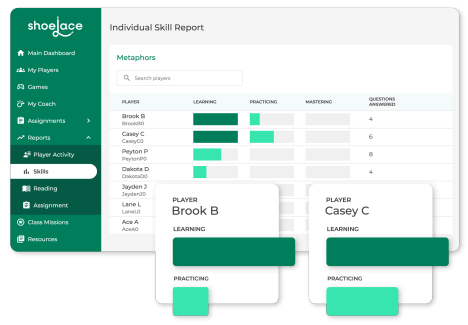
● Real-time skill-level data that shows not just performance, but progression
Connecting MAP Data to Accelerated Practice
Shoelace’s MAP alignment approach helps Michigan educators move directly from RIT scores to purposeful instruction by:
● Translating RIT score ranges into reading skills that should be prioritized by teachers
● Identifying where students need breadth versus depth of practice
● Allowing teachers to assign targeted skill or passage-based practice with confidence
As students work, teachers see live data showing movement from Learning to Practicing to Mastery, enabling timely instructional adjustments and more effective small-group support.
“I'm able to assign lessons that correlate with my current curriculum or by need. It allows me to very easily differentiate the skills students are working on to better target their areas of need.”
Victoria AgneTeacher, Newaygo Public Schools, Michigan
Leadership That Enables Acceleration
Michigan superintendents and principals, accelerating literacy outcomes—especially for adolescent learners—need systems that reduce complexity for teachers rather than add to it.
When objective assessment data, adaptive practice, and real-time instructional insight work together, teachers spend less time interpreting reports and more time delivering targeted support. The result is faster growth, stronger engagement, and renewed confidence—for both students and educators.
More specific information about the MAP–Shoelace alignment resource, including a free downloadable resource, are available on the Shoelace Learning website.